
Bathroom renovations in Bendigo
A bathroom is the smallest room in the house and the one with the least room for error. Waterproofing, fall to the drain, ventilation and the order the trades work in decide whether it still looks right in ten years. We do the whole job, from stripping out to the last silicone, and Brad is on site for it.
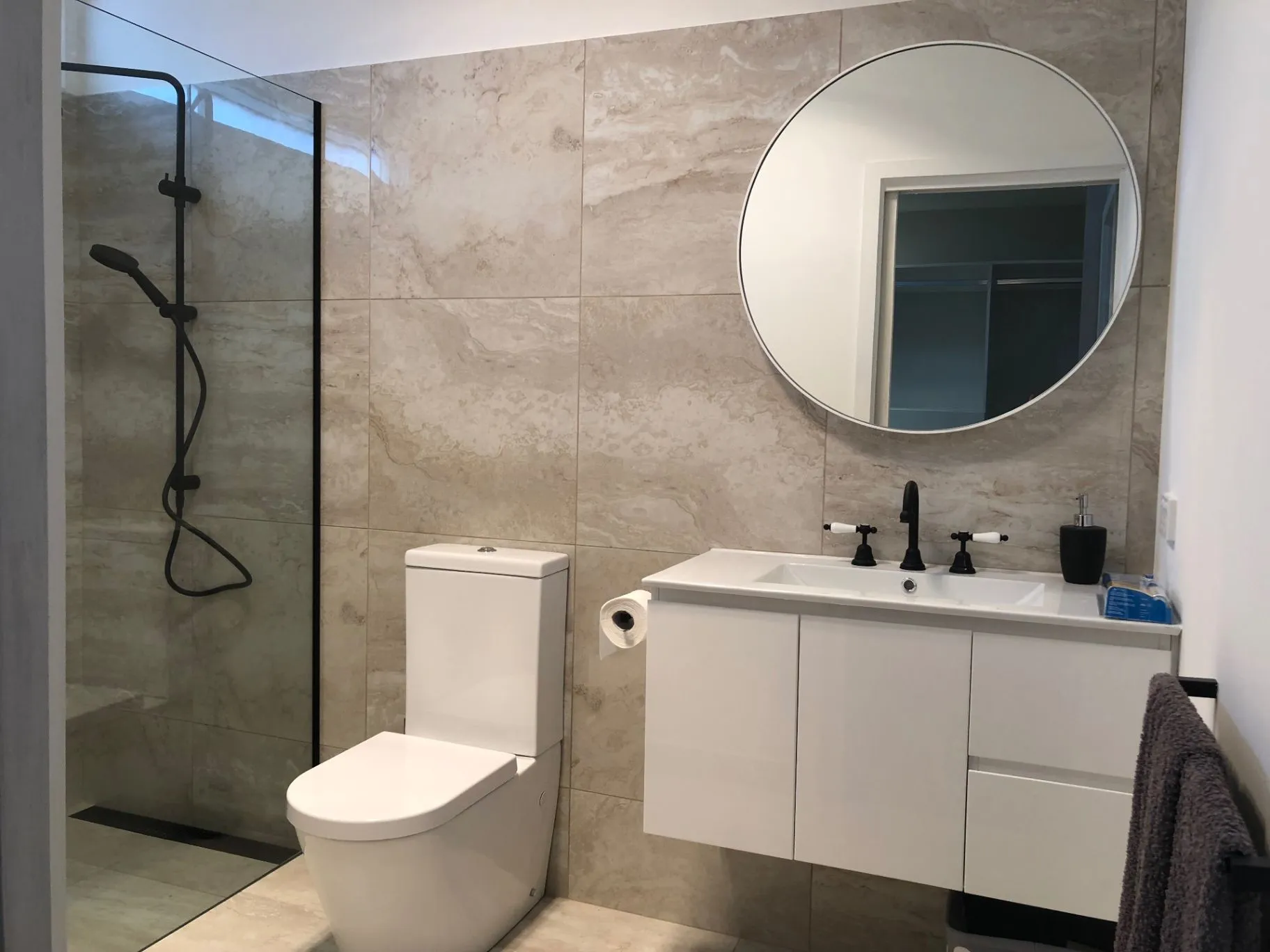
What we take on
- Full bathroom renovations, stripped back to the frame and rebuilt
- Bathrooms reconfigured rather than replaced in the same spot
- Ensuites and powder rooms added or reworked
- Bathrooms made accessible, including hobless showers and wider doorways
- Laundries done at the same time, since the plumbing usually runs between them
What actually decides whether a bathroom lasts
Most of a bathroom is hidden by the time it is finished. The parts nobody photographs are the parts that fail.
Waterproofing
A bathroom is a wet area, and the waterproofing membrane sits under the tiles. It has to be continuous, it has to turn up the wall behind the skirting line rather than stopping at the floor, and it has to be applied to a substrate that is sound and dry. Get that wrong and the failure shows up years later as a swollen door frame in the next room, not as a puddle on the floor.
We do not tile over a bathroom until the waterproofing has been inspected and signed off.
Fall to the drain
Water has to leave the floor. That is a screed decision made before the tiles are laid, and it is the reason a shower that pools is a building fault rather than a cleaning problem.
Ventilation
A bathroom with no path for steam out is a bathroom that grows mould behind the paint. Extraction has to be sized to the room, ducted to the outside rather than into the roof space, and where the room has no window, the extractor is doing all the work.
The sequence
Strip out, framing and any structural changes, rough-in plumbing and electrical, sheeting, waterproofing and its inspection, tiling, then fit-off. When the order gets compressed to save time, the things that get skipped are the ones under the tiles.
One thing we do differently
We do not put windows in showers.
It is a design position, and it comes from doing the work. A window in a shower has to be waterproofed on every edge, it has to deal with a sill that collects water, and the join between a window frame and a wet wall is one of the hardest details in a bathroom to get right and keep right. Timber frames in that position move. Aluminium ones corrode. Either way you are asking a detail that has a hard job to also survive being rained on from the inside every morning.
So the window goes somewhere else in the room — high, or on the wall beside the shower rather than in it — and the shower gets a fixed panel and good lighting instead. If the room only works with a window in the shower, we will say so early and talk about what else has to change.
What you have to decide, and when
Most bathroom decisions are cheap at the start and expensive once the sheeting is on.
- Layout, first. Where the shower, the bath, the toilet and the vanity sit. Moving a toilet or a shower is a drainage decision, so it is settled before anything is ordered.
- Bath or no bath. A bath that fits nobody comfortably is a waste of the best space in the room. If there is a second bathroom, this is worth a real conversation.
- Shower type. A hobless walk-in shower is easier to use and easier to clean, and it needs the fall and the waterproofing set up for it from the start.
- Tiles and finishes, before the sheeting goes on. Lead time is the issue, not the choice.
- Accessibility, if it might matter later. Grab rail backing and a wider doorway cost almost nothing during the build and a great deal after.
Why bathroom jobs go wrong
The failures are consistent.
A bathroom that was built over a wet area that was never properly waterproofed, discovered when the new tiles come off. Layouts moved after the drainage was set, so the floor ends up with two falls and one puddle. Extraction fitted as an afterthought into a ceiling that has nowhere to duct to. Tiling started before the waterproofing was inspected. A budget spent on the visible finishes and nothing held back for what is behind the wall.
None of those are finish problems. They are all decisions made too late, and that is what the first site visit and the written scope exist to prevent.
Bathrooms in Bendigo houses
The housing stock here shapes the work. Post-war brick veneer and weatherboard homes often have bathrooms that were added or extended in stages, with plumbing that has been run through whatever space was available. Older wet areas can have been built to standards that no longer apply, which is only found once the room is opened up.
Cold mornings and hot summers matter too. A bathroom that holds its heat and clears its steam is worth more here than one with a heated floor and no extraction. Where the room has a timber floor, insulation underneath does more for comfort than a bigger towel rail.
Blocks across Bendigo, Kyneton, Castlemaine and the Calder corridor vary enough that the same bathroom plan will not suit all of them. The one constant is that the drainage decides the layout.
How the job runs
- Initial enquiry. Brad answers directly. He asks what the bathroom is doing now and what you want it to do instead.
- Site visit. Brad comes out and looks at the existing plumbing, the floor structure, ventilation routes and access.
- Scope. The work is set out in writing before anything starts.
- Construction. Brad is on site and on the tools, as your one point of contact from strip-out to fit-off.
- Handover. We walk through the finished room together and sort anything outstanding.
Questions we are asked
Do we need to move out during a bathroom renovation?
Usually not, if there is a second bathroom or a working toilet and laundry. Where it is the only bathroom, we plan the sequence so you are without it for the shortest stretch possible, and we tell you which stretch that is before the work starts.
How long will it take?
It depends on what is found when the room is opened up, on lead times for tiles and fittings, and on whether the layout is changing. We do not quote a duration before we have seen the room, because the number would be a guess and you would plan around it.
Can you work with the bathroom we already have rather than replacing everything?
Sometimes, and it is worth asking. If the waterproofing and the drainage are sound, a bathroom can be updated without being rebuilt. If they are not, refitting over the top is money spent twice.
Do you coordinate the other trades?
Yes. Plumbing, electrical, tiling and waterproofing are all arranged and sequenced by us. You deal with Brad.
Can you do the laundry at the same time?
Often, and it usually makes sense. The plumbing runs between the two rooms, so doing them together means opening the wall once.
Talk about your bathroom
BOS Construction works across Bendigo, Kyneton, Castlemaine, the Calder corridor and South Melbourne. Brad O'Shea has 20 years' experience and is on site and on the tools. BOS Construction is a Master Builders Victoria member and a registered building practitioner, BPC DB-U 38574.
Call 0425 808 840 or email info@bosconstruction.com.au. Quote request.
A good place to begin
Start a conversation
Share a few details and Bradley will be in touch.